Thursday, March 24, 2011

Lección Siete: Los Festivales

The Chicago Latino Film Festival, which was founded in 1984, showcases the work of filmmakers from Latin America, Portugal, Spain, and the U.S. For two weeks in April, tens of thousands of movie fans and aficionados flock to the Windy City to view more than 100 films in genres such as fiction, animation, documentary, and shorts.


Each March, Miami's Little Havana neighborhood is the site of the Calle Ocho Carnaval, a bustling street party filled with dancing, music, festive costumes, and ethnic cuisine. Started in 1978 as a celebration of South Florida's Cuban culture, the event now features food and entertainment from across the Latin world. Domino, a popular game in Cuba, is a particular draw. A televised tournament is held at the carnival each year.


In 2007, the first Ibero American Guitar Festival was held in Washington, D.C. The three-day concert staged at the National Museum for the American Indian highlights the diverse heritages and rhythms of guitar musicians from across the Americas and the Iberian Peninsula (Spain and Portugal). Guitar virtuosos strum flamenco, classical, folk, and jazz compositions and pay homage to guitar legends of the past.

The Latin Grammy Awards, the Latino version of the Grammys, is the country's biggest awards show for Spanish-and Portuguese-speaking musicians. Since 2000, industry professionals have nominated artists for awards in 49 categories including Best Latin Rock Album, Best Merengue Album, Best Norteño Band, and Best Brazilian Artist. The competition culminates in an awards show broadcast on national television.

Sunday, March 20, 2011

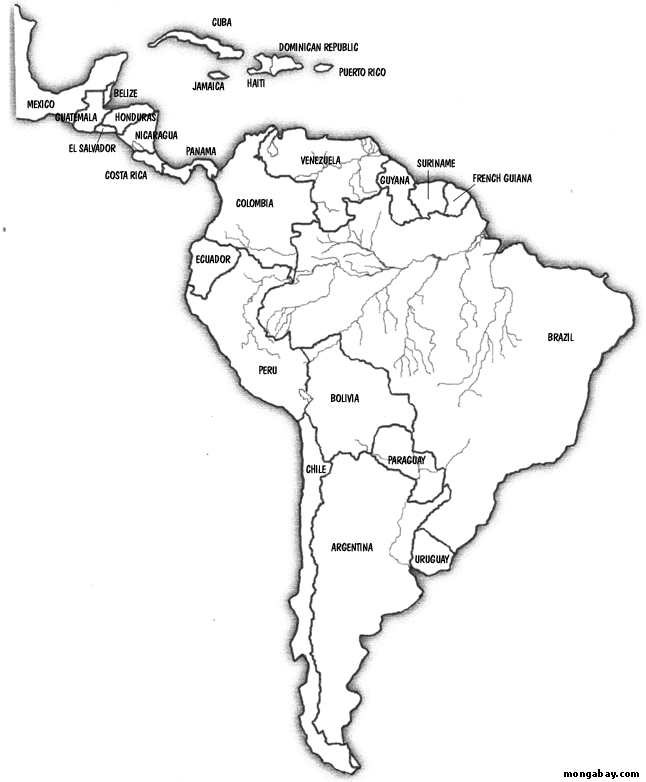
Geografía de Latinoamérica

Muralismo en México

Muralism was an artistic movement that started in Mexico in the 1920s. In the 1920s and 1930s, Mexico was experiencing post-Revolutionary political changes after the 1910-1917 Revolution. In 1921, the Mexican government commissioned Diego Rivera, José Clemente Orozco, and David Alfaro Siqueiros to paint huge murals on the walls of public buildings. This was part of a cultural program designed to promote art among the entire population. The project began the Mexican Mural Renaissance.


One goal of the murals was to make the artwork accessible to all people; everybody that would walk by the building could enjoy the art work. They were also used as a form of propaganda: artists painted murals to express their political beliefs and other social themes.


Of the great three, Diego Rivera is the most well-known. He was born in 1886 in Guanajuato, Mexico. Rivera was member of the Mexican Communist Party, and he portrayed his communist beliefs through his art.

Jose Clemente Orozco was born in 1883 in Zapotlán el Grande, Mexico. He used art to depict the truth, using realism techniques. He showed man’s fascination with machinery, as well as the suffering of the oppressed. Orozco spent 10 years painting in the United States. He returned to Mexico in 1934 and painted the "Man of Fire," which is on the interior walls of the Hospicio Cabañas in Guadalajara and it is considered his masterpiece.


David Alfaro Siqueiros was born in 1896 in Chihuahua, Mexico. He began his political career early, and he frequently spoke and acted out against the government. Siqueiros was an active Marxist, and he often painted about the struggle against fascism, as well as the oppression of all people. Like Rivera and Orozco, Siqueiros studied and painted in the United States and Europe as well as in Mexico.


Monday, March 7, 2011

Lección 4: La comida latinoamericana.

When I think of Latin American foods I think of tacos and nachos.


Chifa is a mix of Chinese and Latin food. Chifa was created in the late 19th century. It began when Chinese immigrants arrived in Peru. The immigrants brought with them their knowledge and the cooking traditions of China. When they added their ingredients and culinary customs of Peru, Chifa was born.


Puerto Rican cuisine was also influenced by other cultures. The African influence came to Puerto Rico in the form of enslaved Africans who were sent to work on sugar plantations in the New World. Coconuts, coffee, gandules (pigeon peas), and plátanos (plantains) are among the new ingredients introduced to Puerto Rico from Africa. Some scholars also believe that the practice of deep frying was introduced by enslaved Africans.


I would pefer the Puerto Rican food because of its African influence.


Leccion Tres: Los animales de latinoamerica

Jaguar is a type of large cat. It is found in Mexico and Central America. Jaguars are carnivores and good hunters. The jaguar played an important role in the religions of Aztec, Mayan, and Incan peoples.


The howler monkey is the native of Central and South America. They are called howler monkeys because of the tremendous noise they make: they can be heard up to three miles away. Besides being known for its loud voice, the howler monkey is also unique for its tail, which it uses like another hand.


Quetzal is a bird.The bird is featured on Guatemala's currency and is considered one of the country's symbols.In addition, some cultures have considered the quetzal a sacred bird.


Capybaras are herbivores: they graze on grasses and water plants. Their home is South America.


Capybaras are social, and they can be found in groups as large as thirty. Adult male capybaras mate with and are in charge of several females and their babies.


Humans raise capybaras for food and they are seen as a delicacy. This is especially important in South America, as the Catholic tradition of Lent forbids the eating of meat. Clergy decided to classify capybara meat as fish, which made them okay for Catholics to eat.


Lección Dos: Cortés y Bolívar

Hernán Cortés is one of the first and most famous Spanish conquistadores of the Americas. In 1519, Cortés decided to conquer modern day Mexico, the home of the Aztec. After Cortés conquered the capital, he was forced to abandon it temporarily in order to fight off another Spanish army. When he returned, the Aztec were revolting against Spanish rule. This time, Cortés was forced to take military action against the Aztec. As they fought Cortés, the Aztec population was reduced by disease and starvation and soon the Aztec gave into Spanish rule. By 1521, the city was back under Spanish control.


Simón Bolívar who is known by this nickname because of his struggle to free the Spanish-controlled colonies in Central and South America. Which is how he earned his Spanish nickname, "El Libertador."

Leccon Dos- La Feria


1. Me gusta montar en la rueda de Chicago.
2. Ella se divierte las golosinas, el algodón de azúcar, las palomitas, y la hamburguesa.
3. El se espanta de la casa del espanto.
4. Me no gustan los coches chocones.
5. La chica pequeña se sube el carrusel
(ask me to check your sentences for accuracy)